

Aprèslude, 2001
Installation/installation
mixed media
220 x 300 x 560 cm
Sammlung Lenbachhaus/Lenbachhaus Collection, Munich
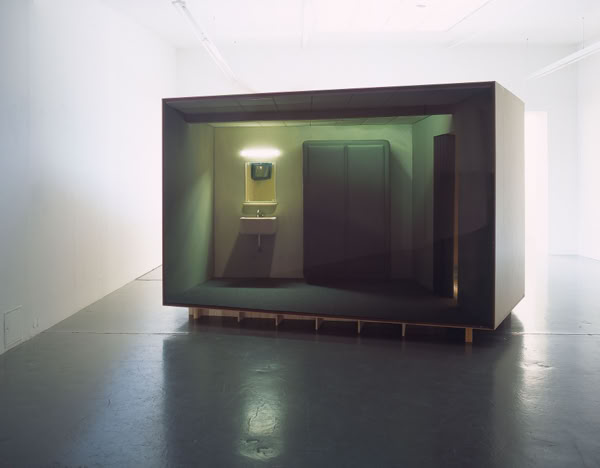
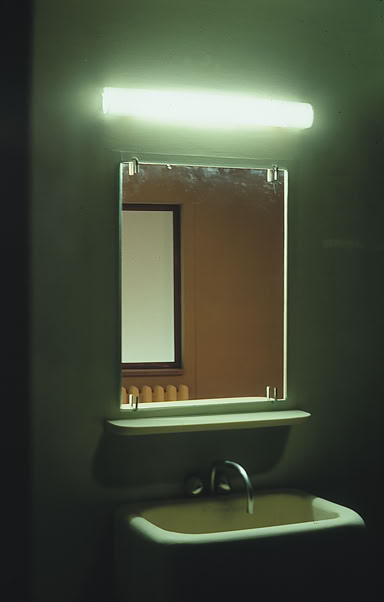
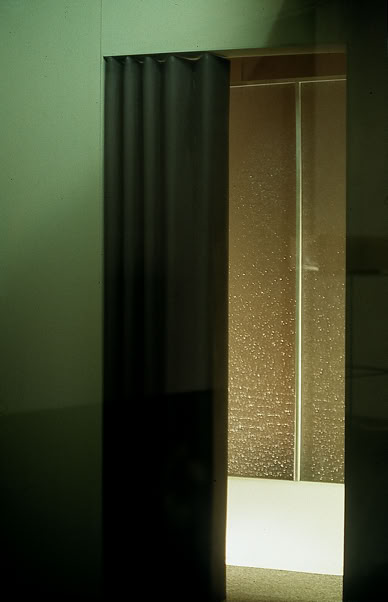
Auf der linken Seite der Stirnwand befindet sich ein Waschbecken. Darüber hängen ein Spiegel und eine Lampe. Neben dem Waschplatz sind in merkwürdig massiger Präsenz die Türen eines Schrankes sichtbar. An der rechten Wand des mit einem dunklen Teppich ausgelegten und grünlich gestrichenen Raumes gibt ein halb geöffneter Faltvorhang den Blick frei auf einen Nebenraum, in dem eine Duschkabine zu sehen ist. In dem Spiegelbild über dem Waschtisch sind ein Monitor und ein Fenster erkennbar. Existierten für diese Spiegelungen reale Pendants, würden diese außerhalb des Bildraumes im Rücken des Betrachters liegen.
Die dem Spiegel zugeschriebene Funktion, getreue Wiedergabe und Widerschein der Wirklichkeit, wird in dieser Raumkonstruktion gerade durch dessen Aussparung sinnfällig. Der vorgetäuschte Spiegel tritt als Regisseur einer eigenen Wirklichkeit auf und wird in der Verkehrung beziehungsweise Täuschung zum Impulsgeber und Motor der Fiktionalität. Im Zusammenspiel mit Monitor und Fenster erweitert er den Raum faktisch und imaginär. Er öffnet einen Raum, in den wir eindringen, und wirft uns statt der dinglichen Wirklichkeit unseren eindringenden Blick zurück.
Aprèslude wurde 2001 in der Galerie Six Friedrich Lisa Ungar in München gezeigt und im selben Jahr in den Hallen des Arsenale unter der Leitung von Harald Szeemann auf der 49. Biennale von Venedig..
Photo credits: Florian Holzherr
On the left of the front wall is a washbasin. Above it hang a mirror and a lamp. Visible next to the washbasin are, in their strangely bulky presence, the doors of a wardrobe. On the right wall of a dark-carpeted and green-painted room, a half opened folding curtain allows a view into an adjoining room, in which a shower cubicle can be seen. In the reflected image over the washbasin, a monitor and a window can be recognised. If these reflections had real existing counterparts, they would lie outside of the depicted space and behind the backs of the observers.
The mirror’s attributive function, supposed reproduction and reflex of reality, is manifest in this constructed space precisely through its cut. The switched mirror appears as the director of its own reality and becomes – through its confusion, or rather, illusion – an impulse-giver and motor of fictionality. In collaboration with the monitor and window, it factually and imaginarily expands the room. It opens a space into which we penetrate and reflects back, instead of the physical reality, our own penetrative gaze.
Aprèslude was exhibited in 2001 at the Galerie Six Friedrich Lisa Ungar in Munich and, in the same year, in the halls of the Arsenale under the direction of Harald Szeemann at the 49th Venice Biennale.